Friday, August 18, 2017

World Rogaine Championships
It was supposed to take us less than 4 hours to drive to the Rogaine venue, but between stopping to do last minute shopping and a construction project that took 1 hour to travel 13 km, it took all day to get there.
We found a lovely spot to have our lunch, in the shade of a Lutheran Church on the banks of the Daugava River.

We were directed to park and erect our tent in a field, pushed up as close as possible to the next tent; they were expecting 1000 contestants, and that's a lot of tents.
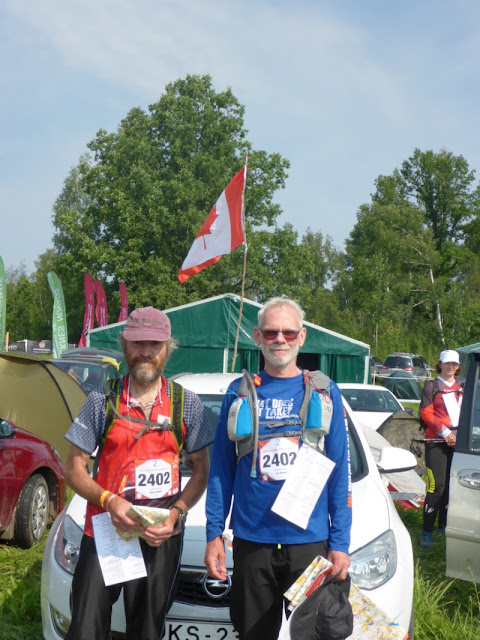
Bryan's wife had picked up a Canadian flag at the dollar store and Leo and Brian wasted no time in erecting it. Just as Bryan predicted, it was an instant friend maker. A Ukrainian contestant came over and played "O Canada" on his cellphone.

Our Polish neighbours came over and introduced themselves. Later a Latvian immigrant to Vancouver came to introduce herself, home for a visit and to compete.

Canadian flag flies proudly over the busy site
The morning of the event the skies opened up with heavy thundershowers, but the sun came out and things dried out for the start.
And they are off:

Couple of things we've learned about Latvia:
Orienteering is Latvia's most popular sport!
Latvia calls itself the WiFi Capital of Europe, with free wifi Hotspots everywhere you go (except maybe in a farmer's backyard or at Riga City Camping!), including here at the Rogaine championships in the middle of a field in the very outer limits of the country. (The border with Russia is only km away, and the contestants have been told to carry their passports with them in case they get questioned by border guards.)
With the event begun, I have 24 hours to kill, which involves getting this blog up to dateand charging all the devices at the handy recharging station.

We found a lovely spot to have our lunch, in the shade of a Lutheran Church on the banks of the Daugava River.

We were directed to park and erect our tent in a field, pushed up as close as possible to the next tent; they were expecting 1000 contestants, and that's a lot of tents.
Bryan's wife had picked up a Canadian flag at the dollar store and Leo and Brian wasted no time in erecting it. Just as Bryan predicted, it was an instant friend maker. A Ukrainian contestant came over and played "O Canada" on his cellphone.

Our new Ukrainian friend emailed us this picture of us chatting with our Polish neighbours
Our Polish neighbours came over and introduced themselves. Later a Latvian immigrant to Vancouver came to introduce herself, home for a visit and to compete.

Canadian flag flies proudly over the busy site

All ready to go
And they are off:

Couple of things we've learned about Latvia:
Orienteering is Latvia's most popular sport!
Latvia calls itself the WiFi Capital of Europe, with free wifi Hotspots everywhere you go (except maybe in a farmer's backyard or at Riga City Camping!), including here at the Rogaine championships in the middle of a field in the very outer limits of the country. (The border with Russia is only km away, and the contestants have been told to carry their passports with them in case they get questioned by border guards.)
With the event begun, I have 24 hours to kill, which involves getting this blog up to dateand charging all the devices at the handy recharging station.

Back to Riga
It was time to go back to Riga, pick up Leo's Rogaine partner Bryan at the airport, and head to the World Rogaine Event in South Eastern Latvia.

On our drive back to Riga, we stopped at Engures Ezers, an ecological reserve. There very big on observational towers in Latvia, perhaps because the landscape is pretty flat and there's not that many places to look out over the landscape? We've climbed up several already (and one church tower), but this was the first where there actually were birds to observe.
Interestingly, in order to restore the natural grasslands and keep the lake from filling in with weeds, they have introduced special old breeds of cattle and a breed of Polish horses believed to be close to the original wild steppe horses!
We were the only tourists who climbed the tower, everyone else wanted to hang out with the not-so-wild horses.
We set up at Riga City Camping for the night, chosen for its proximity to the airport and because we could walk across the Daugava River Bridge and be in Old Town Riga in half an hour.

We had supper downtown and then drove out to the airport to pick up Bryan.
Latvian word of the day: Ezers = Lake
Slitere National Park
From Kuldiga we headed West and then north to Slitere National Park on the seashore. Driving along you don't get a view of the sea at all. Between the road and the sea are farmsteads, then forest, and then dunes.
From the highway roads lead to small fishing villages, usually with a sign for a campsite. We chose one and wound up in the village of Poltrigs. The campsite (kempings in Latvian) was in a farmer's pasture, next to his house. When we showed up he got his daughter who spoke good English, and she showed us around. There was an outhouse (with electric lights!), a hot shower, and an electric kettle for us to boil water in. There were also two cabins.

The people who live here are Livs, a minority related to the Finns who are fighting to keep their culture alive. Our host had constructed a fence showing the variety of traditional fences. It reminded me of Cariboo ranch fences.

From the campsite it was a short walk past old wooden houses, through lovely mixed forest, to a boardwalk constructed with European Economic Community funding over the dunes to the beach.

We visited Cape Kolka at the tip of the Peninsula where the Gulf of Riga meets the Irbe Strait,

and checked out the Slitere Lighthouse, located miles from the shore in the Blue Hills, high enough to be seen for many miles.

The lighthouse was closed, but there was a nature trail that descended down from the hill into unique forest and boglands.

Interestingly, Slitere National Park was originally created to protect this unique ecosystem and English Ivy, which normally does not grow this far north and is considered to have been a refugium from the iceage.
We did not see ivy but we did find cranberries (protected, no picking!) In the bog.

Strange animal of the day: A slow worm, or legless lizard

which we thought was a snake with its tail broken off till we learned better. It sat perfectly still, thus the name slow worm? According to Wikipedia " In the days leading up to birth, the female can often be seen basking in the sun on a warm road," and that's exactly how we found it.
From the highway roads lead to small fishing villages, usually with a sign for a campsite. We chose one and wound up in the village of Poltrigs. The campsite (kempings in Latvian) was in a farmer's pasture, next to his house. When we showed up he got his daughter who spoke good English, and she showed us around. There was an outhouse (with electric lights!), a hot shower, and an electric kettle for us to boil water in. There were also two cabins.

The people who live here are Livs, a minority related to the Finns who are fighting to keep their culture alive. Our host had constructed a fence showing the variety of traditional fences. It reminded me of Cariboo ranch fences.

From the campsite it was a short walk past old wooden houses, through lovely mixed forest, to a boardwalk constructed with European Economic Community funding over the dunes to the beach.

We visited Cape Kolka at the tip of the Peninsula where the Gulf of Riga meets the Irbe Strait,

Irbe Strait water (rough) meets Gulf of Riga water (smooth)
and checked out the Slitere Lighthouse, located miles from the shore in the Blue Hills, high enough to be seen for many miles.

The lighthouse was closed, but there was a nature trail that descended down from the hill into unique forest and boglands.

Interestingly, Slitere National Park was originally created to protect this unique ecosystem and English Ivy, which normally does not grow this far north and is considered to have been a refugium from the iceage.
We did not see ivy but we did find cranberries (protected, no picking!) In the bog.
Strange animal of the day: A slow worm, or legless lizard

which we thought was a snake with its tail broken off till we learned better. It sat perfectly still, thus the name slow worm? According to Wikipedia " In the days leading up to birth, the female can often be seen basking in the sun on a warm road," and that's exactly how we found it.
Thursday, August 17, 2017
Europe's Widest Waterfall

When we stayed overnight in Vancouver at our friend's place they had google Latvia to see what was worth seeing. Ann-Marie mentioned Europe's Widest Waterfall, I scoffed because it's only 6 feet high. But then as luck had it there was a half marathon in Kuldiga that weekend. And we camped right next to Europe's Widest waterfall!

And it was great! We swam every day, along with all the locals. You can perch on a rock right under the falls and pummel your back.
The town of Kuldiga is small and beautiful with lots of old houses and a beautiful bridge that gives you a great view of Latvia's Niagara.
The race didn't start till ten o'clock and by then it was in the mid-twenties. Leo found out that running a half marathon in the heat with jetlag is not very much fun. But I guess it is good practice for the ordeal of a 24 hour orienteering competition.

We 😊Latvia
While we've been having trouble finding both wifi and power for our computer, so far we're loving Latvia.
Thursday, August 10, 2017
Last Day on Haida Gwaii
On our last day on Haida Gwai we returned to Graham Island and visited the Haida Heritage Centre in Skidegate.

It was built to house the cultural artifacts repatriated tothe Islands from museum collections around the world.
The buildings are based on the traditional longhouse in a spectacular location on the shore. There's a deck looking out over the water, and just below were several Birds of the Day, pigeon guillemots, voted cutest birds of the trip:

The insides of their mouths are also bright red!
We camped at Kagan Bay Rec Site, the least spectacular and buggies site of the trip. But we still managed to have our dining room on the beach.

The next morning we caught the ferry back to Prince Rupert:

Farewell, Haida Gwaii
Subscribe to:
Posts (Atom)